

Why an Emotional Intelligence Test Gives You Fast ROI

Employers already tell you what they want. The World Economic Forum’s Future of Jobs Report 2025 surveyed large employers worldwide. Of those employers, 67% call resilience, flexibility and agility a core skill, 52% name motivation and self-awareness, and 50% name empathy and active listening. Psychologists group these skills under emotional intelligence: reading your own emotions, reading other people’s, and choosing how you respond to both.
Your degree does not measure any of that. An emotional intelligence test does. It gives you a baseline in minutes, so you stop guessing whether your people skills are strong, average, or weak. Think of it like a trial balance in accounting. It does not fix anything, but it shows exactly where the numbers fail to add up.
Speed matters when you are 17 or 22. Finding a blind spot early gives you more months to fix it. A teenager who snaps at group-project partners loses allies before the semester ends. A new hire who goes silent after feedback leaves the manager guessing. An emotional intelligence test names these patterns while they still cost you little.
The return is simple. You spend a short block of time, and some versions charge a modest fee. In exchange, you pick one skill to train instead of trying to improve ten at once. Focus is the real product here, and focus saves time.
What the Research Says, and Where It Stops

Weak claims waste your time, so here is the honest evidence. In 2011, O’Boyle and colleagues published a meta-analysis in the Journal of Organizational Behavior. They included 65% more studies than an earlier review, with more than twice the sample size. They sorted emotional intelligence research into three streams: ability-based tests with objective questions, self-report or peer-report measures built on the four-branch model, and mixed models of emotional competencies.
All three streams correlated between 0.24 and 0.30 with job performance. The authors also tested for publication bias and found it had negligible influence on the results.
That number is moderate, and you should read it that way. A correlation of 0.24 to 0.30 does not promise a promotion to anyone with a high score. It says that, on average, people who score higher on emotional intelligence measures tend to perform somewhat better at work.
Critics add a fair warning. A later meta-analysis by Joseph, Jin, Newman and O’Boyle found that self-reported mixed emotional intelligence correlated 0.29 with supervisor-rated performance. That relationship shrank to nearly nothing (−0.02) once the researchers controlled for overlapping traits: conscientiousness, emotional stability, extraversion, and general mental ability. In plain words, self-report tests partly measure personality and confidence you already have.
So treat your emotional intelligence test as a mirror, not a verdict. Choose carefully. Self-report tools ask you to rate yourself, which makes them quick but easy to flatter. Ability-based tests ask questions with better and worse answers, so you cannot simply talk yourself up. Take whichever you can access, then confirm the result against real feedback from people around you.
How Teenagers Can Use an Emotional Intelligence Test
You do not need a job to benefit. Your school, your sports team, your side hustle, and your family all run on the same skills the test examines. Here is a three-step method that works on a student schedule.
First, take the emotional intelligence test once, honestly, when you feel calm. If you answer while angry or after a great day, your mood contaminates the result.
Second, find your lowest area and write it as a behavior, not a label. “Low self-regulation” gives you nothing to do. “I reply to messages within seconds when I feel insulted” gives you something to change.
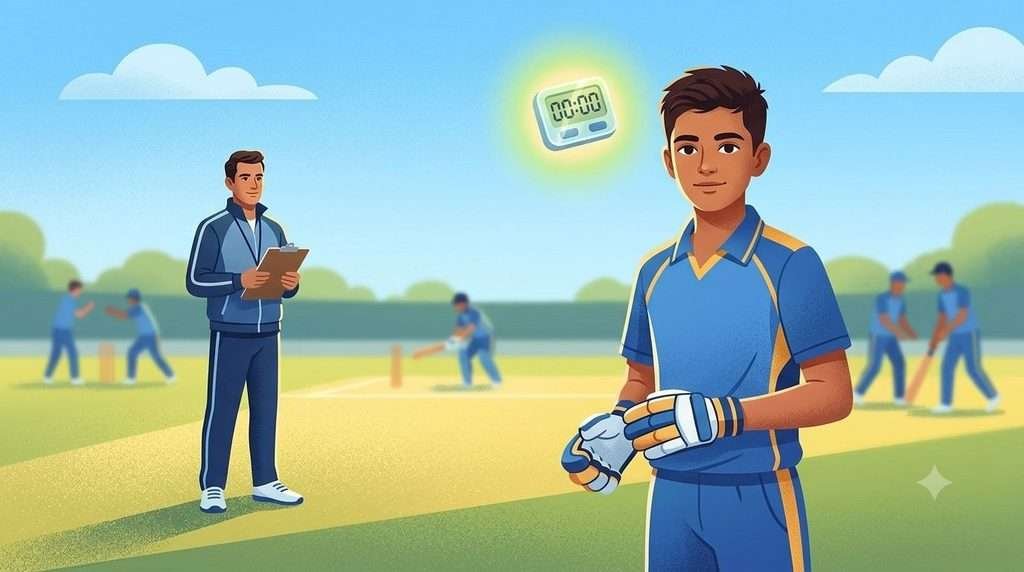
Third, run one small experiment for two weeks. Picture a student named Arjun who sees that he reacts instantly to criticism during cricket practice. He sets one rule: wait ten seconds, then answer the coach with one question. After two weeks, he notes whether arguments dropped. That is a real feedback loop with a clear measurement, and it costs nothing.
Teenagers also gain a language advantage. Most people cannot explain why a conversation went badly. After a good emotional intelligence test, you can say, “I misread his tone, and I responded to my assumption instead of his words.” That sentence alone separates you from classmates who just say, “He is annoying.”
How New Office Goers Turn an Emotional Intelligence Test Into Results

Your first job rewards a different set of habits than college did. Nobody hands you a syllabus. Your manager judges you by how you handle ambiguity, feedback, and colleagues who disagree with you. An emotional intelligence test points at those exact pressure points.
Use the result in your first ninety days. Take the test in week one, then book a short chat with your manager or a trusted senior. Share one finding and ask for one example. For instance: “My result says I struggle to read tone in group calls. Did you notice that in my last presentation?” This move shows self-awareness, which sits on the same WEF list of core skills employers value. It also gives you a real example from someone who watches your work, and that example matters more than the score itself.
Now apply it to a common scenario. Imagine Neha, a new analyst whose report receives three red-marked corrections. Her old pattern is to defend every line. Her emotional intelligence test flagged weak emotion regulation under criticism, so she changes one habit. She writes down each correction, waits an hour, and replies with a revised draft and a thank-you. Her manager now sees a person who improves fast. Neha did not become smarter. She became easier to coach, and managers promote people they can coach.
Retake the emotional intelligence test after three to six months. Compare the two results, and compare them against what colleagues say. If your score rises but nobody around you notices a change, your self-assessment has drifted from reality. If both move together, your training works.
Do not stop at the score. The World Economic Forum estimates that around 39% of current skills could change or become obsolete between 2025 and 2030, and the skills at the top of its employer list involve adapting and working with people. An emotional intelligence test cannot guarantee your success. It can show you which of those skills to build first, and that head start compounds.
Take the test, pick one weak behavior, and test a fix for two weeks. Cheap experiments beat expensive guesses every time.
Written by mylifeconvert.com
External resources (facts used above)
- World Economic Forum, The Future of Jobs Report 2025, Skills Outlook chapter: https://www.weforum.org/publications/the-future-of-jobs-report-2025/in-full/3-skills-outlook/
- O’Boyle, Humphrey, Pollack, Hawver & Story (2011), “The relation between emotional intelligence and job performance: A meta-analysis,” Journal of Organizational Behavior, 32(5), 788–818. Summary: https://news.vcu.edu/article/study_emotional_intelligence_predicts_job_performance
- Joseph, Jin, Newman & O’Boyle, “Why Does Self-Reported Emotional Intelligence Predict Job Performance? A Meta-Analytic Investigation of Mixed EI,” Journal of Applied Psychology: https://stars.library.ucf.edu/facultybib2010/6608