
Life Convert

admin

Free SEO Checker: The Fastest First Audit for Series A Founders 

A Free SEO Checker costs nothing, takes minutes, and shows Series A founders exactly where their organic growth leaks. Organic Search Rewards the Founders Who Audit First Organic search carries more than half of trackable web traffic. BrightEdge measured an average organic share of 53.3% across industries and found that B2B companies generate twice as much revenue from organic search as from any other channel. For B2B sites, organic and paid search combined average 76% of traffic. If you sell to businesses, that share belongs in your growth model. brightedgebrightedge The same channel punishes neglect. Ahrefs studied roughly 14 billion pages from its Content Explorer database and found that 96.55% of them get zero traffic from Google. Those two numbers frame your decision. The channel is huge, and most pages never reach it. ahrefsahrefs A Free SEO Checker gives you the first diagnostic. It scans a page and reports the technical and on-page problems that keep that page out of the small group that earns visits. Run a Free SEO Checker on your homepage, your pricing page, and your three highest-intent product pages. Then sort the findings by effort and revenue impact. You skip the theory and get a repair list. Series A founders answer to boards that ask about efficiency. A Free SEO Checker delivers an audit without a purchase order, a vendor call, or a contract. You can assign the first fixes to an engineer the same afternoon. A Free SEO Checker Beats a Retainer for the First Audit Professional SEO carries a real price. Ahrefs data puts the average cost of SEO at $2,917 per month. Ahrefs also reports that 78.2% of SEOs charge monthly retainers for some or all of their services. A retainer buys strategy, execution, and reporting. It should not buy the discovery that your pages lack basic metadata. A Free SEO Checker finds those basics for free. colorlibahrefs Basic errors appear almost everywhere. Ahrefs data shows that 72.3% of sites have slow pages, 95.2% have 3XX redirect issues, and 88% have HTTP-to-HTTPS redirect issues. Among top-ranking pages, 7.4% have no title tag and 25.02% have no meta description. Those figures cut two ways. Your competitors carry the same gaps, so fixing yours creates an edge. And you should not assume your site is clean just because your engineers ship fast. Run the Free SEO Checker and verify. ahrefsahrefs Use the report as a scoping document. Pick the five issues that touch revenue pages first, such as the pricing page, the demo-request page, and the comparison pages. Hand that list to one engineer and one marketer, and give them a one-week deadline. After the fixes ship, re-run the Free SEO Checker and compare the two reports. If the issue count dropped, the sprint worked. If organic sessions rise in the weeks after, you have evidence to justify a larger investment. That sequence respects your constraints. It costs hours instead of a quarter’s budget, and it produces a before-and-after record your board can read in two minutes. Free Tools Compound: The Ahrefs Backlink Checker Example Ahrefs offers a real case of a free utility paying off. In 2018, Ahrefs re-optimized its free backlink checker page for search intent. Estimated organic visits to that page grew from roughly 14,000 per month before the change to almost 200,000. ahrefsahrefs That case does not prove a Free SEO Checker audit will deliver the same lift for your company. It proves something narrower and more useful: a free tool that matches what searchers want can earn sustained search demand. Ahrefs also describes the tactic behind it. Pages that already have many backlinks but little organic traffic and that target a keyword with traffic potential make a quick win when you re-optimize them for search intent. ahrefs Apply that to your site in two steps. First, pair a Free SEO Checker with your backlink data to find pages that attract links but underperform in search. Those pages hold the cheapest wins. Second, check your category for a tool searchers already want, such as a calculator, a grader, or a checker, and audit your competitors’ versions of it. Run a Free SEO Checker on their tool pages and compare title tags, page speed, and metadata against yours. You learn where the gaps sit before you spend a sprint building anything. Treat this as a hypothesis, not a promise. Test it on one page, measure organic sessions for that page, and expand only after the numbers move. Know What a Free SEO Checker Cannot Do A Free SEO Checker audits what exists on your page. It does not create demand. Ahrefs notes that if nobody searches for a topic, the page gets no search traffic even at the top position. The tool also does not build authority. Ahrefs found that pages with more referring domains get more traffic. A clean report tells you the page has no technical excuses. It does not tell you the page deserves to rank. ahrefsahrefs The search results page itself keeps changing. SparkToro’s 2026 study, based on Similarweb data, found that 68% of US Google searches from January to April 2026 ended without a click. Ahrefs associates AI Overviews with a 58% lower average click-through rate for the top-ranking organic page. Those shifts mean you should measure organic sessions and conversions, not just rankings or report scores. colorlibahrefs So treat the Free SEO Checker as step one of three. Step one: audit with the Free SEO Checker and fix the errors on your revenue pages. Step two: choose topics with real search demand and match search intent, which is the advice Ahrefs gives for joining the pages that earn traffic. Step three: earn backlinks to those pages and track organic sessions monthly. Run the Free SEO Checker again after every release that touches templates, navigation, or page speed, so new errors never pile up unseen. A Free SEO Checker will not rank your site, but it stops you from paying to discover problems you could have

Free SEO Checker: The Fastest First Audit for Series A Founders  Read More »
Why Series A Founders Should Hire a Performance Marketing Agency Before Building In-House 

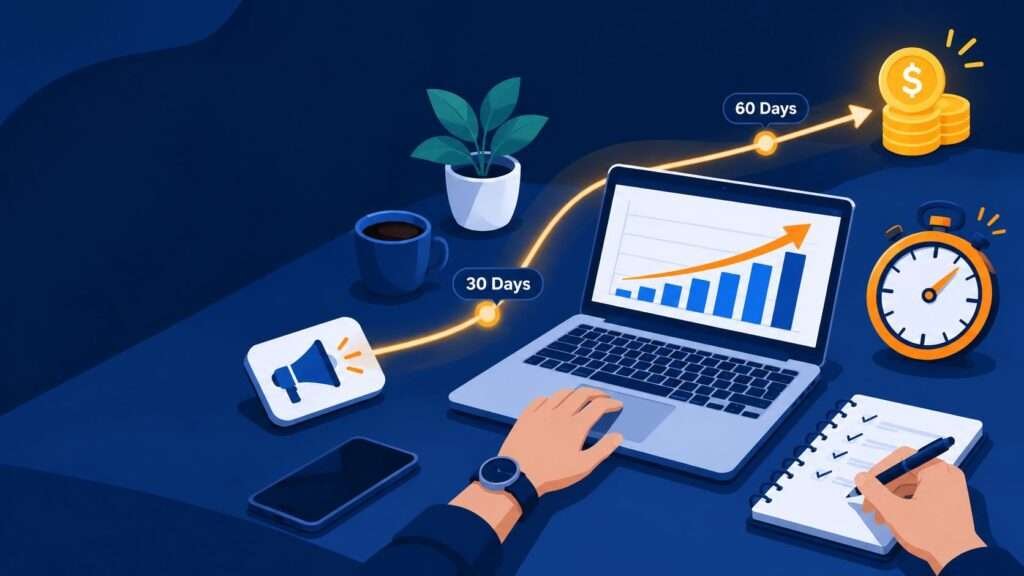
Investors grade payback, and a performance marketing agency optimizes for it Series A diligence boils down to one question: how fast does a customer repay what you spent to win them? Series A investors use 18 months as the standard CAC payback threshold, rate anything under 12 months as strong, and rate anything under 6 months as exceptional. One benchmark roundup puts the median payback at 18 months for Series A startups and 13 months for Series B, with top-quartile companies recovering costs in under 10 months. SaaSHero’s summary of G-Squared benchmarks adds that from Series A onward, investors want a credible path to payback under 18 months within four quarters. payback period saas benchmark 2026 +2 The math is simple. CAC payback equals CAC divided by monthly revenue per customer multiplied by gross margin, so a $1,200 CAC on a $150 monthly customer at 75% gross margin pays back in 10.7 months. Every lever in paid media moves that fraction. Creative changes conversion rate. Bidding changes cost per click. Landing pages change sign-up rate. Tracking decides whether you can trust any of those numbers. averi A performance marketing agency organizes its week around those levers. It optimizes paid advertising for measurable outcomes such as leads, signups, purchases, and revenue instead of reach or impressions. That focus matters when your board asks for payback by cohort and you need an answer that survives a follow-up question. A performance marketing agency that reports cost per click and nothing else has not earned the title, so demand payback, not vanity metrics. upgrowth Speed beats headcount when runway has a clock A head of growth must build a channel mix, a testing process, and a reporting stack from zero. That work takes time before you get the first clean read on payback. A performance marketing agency arrives with those pieces assembled. One agency’s case study says a specialized shop brings tested frameworks for audience targeting, creative testing, and campaign optimization built across dozens of accounts. Agencies write that language about themselves, so verify it with live account examples during the pitch. opascope Flexibility matters just as much. Agencies scale effort up or down with budget and stage, with no hiring or firing. If your first channel stalls, the performance marketing agency moves spend into the next test. A stalled channel under an in-house hire leaves you paying a salary while you rethink the plan. upgrowth Consider Duckbill, a consumer app. Its marketing function was a one-person team with no dedicated paid media expert when it partnered with Primer. Between March and April 2026, Primer cut Duckbill’s Meta cost per purchase by more than 56%. Primer published that result itself, so treat it as a claim to verify. Still, the starting point looks familiar to many Series A teams: lean, stretched, and short on paid media depth. A performance marketing agency covers that gap while you learn which channel deserves a full-time owner. Your first in-house hire then inherits a tested playbook instead of a blank page. goprimergoprimer Real examples show where a performance marketing agency finds money Wicked Reports describes Tier 11 as a performance marketing agency focused on full-funnel growth for DTC brands. On a pet e-commerce account, Tier 11 cut new-customer acquisition cost by 34% and grew new customers by 25% on 2.7% more spend, by fixing what the scoreboard actually measured. wickedreportswickedreports Notice the mechanism. Spend barely moved. Measurement did. If your ad platforms report conversions your CRM never sees, you optimize toward noise, and no creative refresh fixes that. A strong performance marketing agency audits tracking before it moves a dollar of budget. Opascope’s case study shows a second angle. A lifestyle startup spent over $1.4 million per month on Facebook ads and other paid channels to generate $2 million in revenue, and lookalike audiences then reduced total ad spend while sending better-qualified leads to sales. The lesson holds at any budget: better audiences can lower spend and raise lead quality at the same time. opascope Both wins came from tracking and audience quality, not from a clever slogan. Brief your performance marketing agency to start there. Both case studies also come from the agencies themselves or their partners, so neither one is an audit. Ask any performance marketing agency you interview for the raw account data behind its best case: spend, conversions, and payback before and after. An agency that hesitates to share the denominator is telling you something. Hire a performance marketing agency like an investor: evidence first, ownership always Run the search like diligence. Four rules. Test for balance. One startup-focused guide suggests asking for a case where the agency cut CAC by 30% or more while growing monthly customer acquisition by 50% or more within 90 days, and it flags any agency that improves only one of those metrics. Lower CAC on flat volume means the agency shrank your business. upgrowth Define payback with gross margin. Payback must use gross margin contribution, not revenue. Write that into the reporting agreement so the agency’s dashboard matches the math your investors run. pages Budget two lines. Total monthly performance marketing budget equals agency fees plus ad spend. Model both lines in your burn before you sign. upgrowth Keep ownership. Own the ad accounts, the tracking pixel, the analytics property, and the creative library. If your performance marketing agency leaves, your data stays. Then set a 90-day test with a kill rule: name the payback ceiling at which you stop spend, and write it into the contract before the first campaign launches. Finally, ask how the agency handles campaigns that underperform. Look for honest communication and proactive problem-solving, not excuses. upgrowth Series A rewards the founder who proves one repeatable, measured channel fastest. A performance marketing agency gets you that proof while your competitors are still writing job descriptions. Written by mylifeconvert.com External resources (facts used above):

Why Series A Founders Should Hire a Performance Marketing Agency Before Building In-House  Read More »

Soft Skills That Get Freshers Hired and Promoted Faster

Why Employers Rank Soft Skills Above Another Certificate Every year, the National Association of Colleges and Employers (NACE) asks hiring teams what they want to see on a fresher’s resume. In its 2025 survey, nearly 90% of employers wanted evidence that a student can solve problems, and nearly 80% wanted strong teamwork. Written communication, initiative, work ethic, and technical skills each mattered to at least 70% of employers. Look at that list again. Problem-solving, teamwork, communication, and initiative all count as soft skills, and they hold the top spots. nacewebnaceweb Hiring methods now reward these abilities even more. In the 2026 survey, 70% of employers reported using skills-based hiring, up from 65% the year before. Employers also told students to share examples of times they used their skills to solve problems. A degree lists what you studied. A story shows what you can do. nacewebnaceweb Technical skills still matter, and the same survey shows it. But when hundreds of candidates in one batch hold similar degrees and similar certificates, your soft skills become the difference you can prove in a 20-minute interview. Compare two answers. One candidate says, “I know Excel.” Another says, “I rebuilt my club’s attendance sheet, and our team stopped losing an hour every week.” The second answer proves problem-solving, initiative, and ownership in two sentences. (This is an illustrative example, not a statistic.) One warning before we go further. You may have seen a claim that soft skills drive 85% of job success. Those figures were extrapolated from a 1918 Carnegie Foundation study of engineering education, so this article does not rely on them. Current surveys give better evidence. nationalsoftskills How Soft Skills Speed Up Your Learning and Your Career The World Economic Forum (WEF) Future of Jobs Report 2025 draws on more than 1,000 major employers across 55 economies, representing over 14 million workers. In it, analytical thinking ranks first, with about 69% of employers calling it core, and resilience, flexibility, and agility rank second at 67%. Leadership and social influence rank third, with 61% of employers calling them core. Two of the top three groups are people-centred skills, and they are rising fast: leadership and social influence gained 22 percentage points in importance, and resilience, flexibility, and agility gained 17. kiosk.youboox.fr +3 Why does this give you speed? Tools change quickly. The same report expects 39% of core job skills to change by 2030. A software skill from your college project can age within a few years. Listening, adapting, and asking sharp questions travel with you into every new tool, team, and city. Soft skills compound across jobs, while a technical skill resets each time the tool changes. aimresearch Picture two new joiners who learn the same software in the same month. Riya sends her manager a three-line update every evening: what she finished, what blocks her, and what she plans next. Aman works just as hard but stays silent until someone asks. Her manager can see Riya’s progress, so she hands Riya the first client call. Aman’s manager has to guess. (Again, this is an illustrative scenario.) Visibility builds trust, and trust earns bigger tasks. That is the ROI of soft skills in one office week. Five Soft Skills With the Best Return in Your First Year You cannot practice everything at once, so start with the soft skills that employers name most often. These five come straight from the NACE and WEF findings above, and each one costs nothing to practice. Written communication. Put the request or the update in the first line of every email, then add details below. NACE places written communication among the attributes at least 70% of employers want. Problem-solving. Never bring a problem alone. Bring your best guess at the cause and one suggested fix. Your manager can answer yes or no in seconds, and you show the analytical thinking that WEF ranks first. Teamwork. Finish your part early and tell the team where you can help. Nearly 80% of employers in the NACE survey look for this. Initiative. Each month, fix one small, repeated annoyance without waiting for instructions: a messy shared folder, a missing template, a question everyone keeps asking. Adaptability. When priorities change, ask “What should I pause?” instead of defending the old plan. WEF’s second-ranked skill group, resilience, flexibility, and agility, describes exactly this habit. Notice the pattern. Each habit takes under ten minutes a day, and each one produces a story you can use on a resume or in an interview answer. A 30-Day Soft Skills Plan That Fits Around Class or Work Reading about soft skills changes nothing. Repetition does. Use this plan alongside your classes or your first job. Week 1, written clarity. Send one three-line update every day to a mentor, teammate, or manager: done, blocked, next. Week 2, problem stories. Each day, write down one problem you solved in three lines: the problem, your action, and the result. Employers asked for examples, so this notebook becomes your interview bank. Week 3, teamwork. Join one group task and take the unglamorous role: notes, follow-ups, or deadline tracking. Closing loops builds the reliability Riya showed in the earlier example. Week 4, initiative. Write a one-page proposal for one improvement, with a time estimate and a first step. Send it to someone who can approve it. Measure your progress. Count your stories, and ask one person for one sentence of feedback every Friday. After 30 days, you hold a notebook of real examples, four working habits, and proof that your soft skills improve with practice. Technical skills get you into the room, and soft skills decide how long you stay and how high you climb. Freshers who practice them from day one compound their advantage while everyone else waits for a bigger certificate. Written by mylifecovert.com References (facts used above)

Soft Skills That Get Freshers Hired and Promoted Faster Read More »

Self Awareness: The Fastest Skill That Pays You Back in Study, Work, and Money 

Why Most People Fail the Self Awareness Test Ask ten friends whether they know themselves well, and all ten will say yes. Organizational psychologist Tasha Eurich found this exact pattern. Her research team reported in Harvard Business Review that about 95% of people believe they are self-aware, yet only 10–15% of the people they studied met the criteria. Eurich describes the 10–15% figure as an estimate, so read it as a strong warning signal, not a precise census. That gap matters to you for a simple reason: you cannot fix a flaw you cannot see. Psychologists Justin Kruger and David Dunning showed a similar blind spot in 1999. Participants who scored in the bottom quartile on tests of humor, grammar, and logic put their own performance at the 62nd percentile. Their actual scores sat at the 12th percentile. Low skill and low Self Awareness travel together, because the skills you need to judge your work are the same skills you lack. Now apply that to your life. A teenager who believes “I work best under pressure” will keep leaving everything until the last night, even when every result proves otherwise. A new employee who believes “my emails are clear” will keep confusing the team and never learn why replies come back with questions. Neither person lacks talent. Both lack an accurate picture of themselves, and that picture sets the ceiling on everything they try. Eurich makes the same point in an interview with The Art of Manliness: she argues that your Self Awareness sets the upper limit of your effectiveness. Treat that as her interpretation of her research, but the logic holds up in daily life. If your map of yourself is wrong, every decision you make from that map goes wrong too. The Two Halves of Self Awareness Most people practice only half of it. Eurich’s research splits Self Awareness into two parts. Internal Self Awareness means knowing who you are: your values, your goals, your patterns, and your reactions. External Self Awareness means knowing how other people see you. Eurich reported that the two show virtually no relationship, so being strong in one tells you nothing about the other. Here are two hypothetical examples that show the difference. Riya, 22, joins a startup. She knows exactly what she wants: a Product Management career, and she understands that she learns fastest by building things. Her internal Self Awareness is high. But her manager reads her short, rushed updates as lack of effort, and Riya never finds out. Her external Self Awareness is low, so she loses trust without knowing why. Karan, 19, studies for exams and dresses, talks, and posts exactly how his friends expect. Everyone likes him. But when someone asks what he wants from the next five years, he goes blank. His external Self Awareness is high and his internal Self Awareness is low. Eurich warned in a Wharton interview that people who focus too much on how others see them can lose track of their own interests entirely. You need both halves. Internal Self Awareness gives you direction, and external Self Awareness gives you the feedback to correct it. Skip either one, and you run fast in the wrong direction or stand still in the right one. The ROI of Self Awareness: Where It Saves Time and Money Teenagers and new professionals both work with scarce resources: time, attention, and a small budget. Self Awareness helps you spend all three on the right things. Think about it as a return on investment that compounds. It cuts wasted effort. Suppose you notice that you finish deep work in the morning and fade after lunch. You then move difficult tasks to the morning and save routine tasks for later. You do not work harder; you stop fighting your own pattern. One honest observation about yourself removes hours of friction every week. It prevents expensive mistakes. A person who knows they buy things when they feel stressed can set a rule: wait 24 hours before any purchase above a fixed amount. A person who knows they agree to everything in meetings can practice one sentence: “Let me check my schedule and reply today.” Each pattern you name becomes a mistake you stop paying for. It speeds up your career. Early in a job, your manager decides how fast you grow, and managers promote people who take feedback well. If you know how your team sees you, you fix small problems before they become reputations. You also choose roles that match your strengths, so you learn faster and compete better. It sharpens your decisions. When you know your values, you say no to opportunities that look impressive but pull you off course. That single skill saves months. Many people spend years in a degree, a job, or a business that matches someone else’s expectations, and they only notice when the cost is already high. Notice what these gains share: none of them needs money, a mentor, or special talent. They need honest observation, and you can start today. A Five-Minute Self Awareness System You Can Start Today Self Awareness sounds abstract until you attach it to a routine. Use this simple system. Step 1: Ask “what,” not “why.” Eurich’s HBR article recommends this switch. “Why am I so bad at public speaking?” pulls you into excuses and self-blame. “What situations make me most nervous when I speak?” gives you a pattern you can test. Her research also found that people who reflect more are not automatically more self-aware, so the quality of your questions matters more than the quantity of your thinking. Step 2: Write three lines every night. Spend five minutes answering: What did I do today that worked? What did I do that wasted time? What triggered my strongest emotion? After two weeks, patterns appear that you would never spot in your head. Step 3: Collect outside data. Choose two or three people who will tell you the truth, such as a senior colleague, a friend, or

Self Awareness: The Fastest Skill That Pays You Back in Study, Work, and Money  Read More »

Goal Setting for Teenagers and New Employees: Turn Vague Wishes Into Real Results 

Why Goal Setting Beats “I’ll Try My Best” Most teenagers and new hires say “I’ll try my best” and then wonder why their results stay average. Psychologists Edwin Locke and Gary Latham studied that habit for 35 years. They found that asking people to do their best did not produce their best, because do-your-best goals give no external reference point. A vague target has no finish line, so you never know whether you are winning. umn Goal setting fixes this by giving your effort a direction and a scoreboard. Locke and Latham report that goals direct your attention and energize your effort. They also describe a straight-line pattern: the highest or most difficult goals produced the highest levels of effort and performance. Performance leveled off only when people reached the limits of their ability or stopped committing to the goal. locke pract goal setting 2002 am psy +2 Test this in your own life. “Study more” gives you nothing to measure. “Solve 20 past-paper questions by Sunday night” gives you a number, a deadline and a clear yes or no. A new employee who writes “get better at Excel” drifts. One who writes “build a pivot-table report for my manager by Thursday” ships. That is the ROI of goal setting: ten minutes of definition saves hours of unfocused effort. Build a Goal With Three Parts: Specific, Stretching, Time-Bound Strong goal setting follows a simple formula. First, make the goal specific, so a stranger could check whether you hit it. Second, make it hard enough to stretch you. Third, attach a deadline. Stretch matters because easy goals stop pushing you the moment you finish them. But stretch has a ceiling. Locke and Latham found that ability limits the effect, so performance stops climbing once a goal exceeds what you can do. Aim at the edge of your ability, not beyond it. New skills need a different approach. Locke and Latham’s research shows that setting performance goals can hurt results when a task is complex, and a specific, difficult learning goal led to significantly higher performance. Suppose you start your first sales job and have never pitched anyone. “Close five deals this month” can freeze you. “Test three opening lines and record which one gets a reply” teaches you faster, and the deals follow. A teenager learning video editing can use the same trick: “publish three practice edits” beats “go viral.” strategicmanagementinsight Run every goal through four questions before you lock it: The last question carries weight. Locke and Latham tie commitment to how important the goal feels, and self-efficacy, the belief that you can reach the goal, strengthens commitment on its own. Goal setting without commitment produces a nice sentence and no results. strategicmanagementinsightthinkinsights Turn Goal Setting Into Action With If-Then Plans Wanting a goal badly does not make you act on it. One meta-analysis found that a medium-to-large change in commitment (d = 0.66) produced only a small-to-medium change in behavior (d = 0.33). You can feel fully motivated and still fail to start. frontiersin Peter Gollwitzer and Paschal Sheeran tested a fix called an implementation intention. It is an if-then plan that spells out when, where and how you will act. Across 94 independent tests, these plans had a positive effect of medium-to-large size (d = .65) on goal attainment. The review covered more than 8,000 participants, and most studies compared if-then planners with people who already held a goal intention. That makes the result a tougher test than it first looks. uni-konstanzfrontiersin The format takes one sentence: “If [situation], then I will [action].” These plans work because they remove the daily decision about when to begin. Keep the evidence in proportion, though. A later meta-analysis of 642 tests found that the effect size depends on plan format and how motivated the person already is. Treat 0.65 as an average, not a promise. A plan helps most when you already care about the goal. goalsandprogress Add Accountability to Lock In Your Goal Setting Results Writing a goal helps, but sharing your progress helps more. Psychology professor Gail Matthews of Dominican University recruited 267 participants and randomly assigned them to five groups. Group 1 only thought about their goals and accomplished 43 percent of them. Group 5 wrote their goals, wrote action commitments, shared them with a friend and sent weekly progress reports, and accomplished an average of 76 percent. slideshare The university’s summary adds a second angle: more than 70 percent of participants who sent weekly updates to a friend reported successful goal achievement, compared with 35 percent of those who kept goals to themselves without writing them down. dominican Read this study with care. Only 149 of the 267 participants finished, and they rated their own progress. The results do not prove a guaranteed outcome. They do show a clear direction: written goals plus weekly reporting beat private intentions. Make it practical. Pick one person who will read a weekly message from you, such as a classmate, a colleague or a mentor. Send three lines every Friday: the goal, what you finished, and what you do next week. That habit costs five minutes and gives your goal setting a deadline someone else can see. Goal setting costs ten minutes and pays back every week in focus, speed and proof of progress. A vague wish gives you nothing to measure, and a measured goal gives you something to beat. Written by mylifeconvert.com External Resources (fact sources)

Goal Setting for Teenagers and New Employees: Turn Vague Wishes Into Real Results  Read More »

Creative Thinking: The Skill Employers Want and You Can Train in 15 Minutes a Day 

Employers Rank Creative Thinking Near the Top of Their Wish List Employers do not guess about this; they answered a survey. The World Economic Forum questioned more than 1,000 employers for its Future of Jobs Report 2025, and 57% of them named creative thinking a key skill. Only analytical thinking (69%), resilience, flexibility and agility (67%), and leadership and social influence (61%) scored higher. euronewsworkera The same report projects 170 million new roles and 92 million displaced roles by 2030. Put those numbers side by side: jobs change fast, and employers want people who build new approaches when old ones stop working. The report also lists creative thinking among the rising skills for 2025 to 2030. Workera, a skills-training company, adds an opinion worth weighing: it argues that AI has little potential to replace this skill. Future of Jobs Report 2025: 78 million new jobs by 2030 but urgent upskilling needed to prepare workforces +2 Why does that matter to you? A checklist covers problems someone already solved. Creative thinking handles the problems nobody has solved yet. If you are 17 and building a side project, or 22 and sitting in your first team meeting, the person who brings a fresh angle gives the team something it does not already have. Now think about return on investment. This skill costs no tuition: you need a notebook, a timer, and a real problem. The return shows up when your idea saves your team a week or wins your page ten new buyers. You Do Not Need Top Marks to Think Creatively Many students assume creativity belongs to artists or class toppers. Data from the OECD pushes back. In 2022, the PISA assessment tested creative thinking for the first time, across 64 participating countries and economies. PISA defines the skill as the competence to generate, evaluate and improve original and diverse ideas. The tasks looked like real life: inventing a story idea or thinking of different ways to run an awareness campaign in school. introduction ac830e6e +2 The results hold a useful surprise. About half of the students who excelled in creative thinking did not excel in academic subjects, so top grades are not a prerequisite. Around eight in ten students also believe a person can be creative in nearly any subject. For a BBA student or a junior analyst, that means marketing, finance, operations, and HR all leave room for original ideas. teachermagazineoecd Stay honest about the full picture, though. The OECD found that education systems scoring high in creative thinking almost always scored high in mathematics, reading, and science, so strong basics help. Students from disadvantaged backgrounds scored significantly lower, which the OECD attributes partly to challenging environments and under-resourced schools that sideline creative activities. The lesson: the skill responds to practice and surroundings, so you build the practice yourself. oecdoecd Creative Thinking Turns Problems Into Cheap Experiments Business runs on a repeating loop: spot a problem, try something, measure the result. Creative thinking upgrades the “try something” step because it widens your options before you spend money or time. The PISA definition already describes the loop: generate ideas, evaluate them, improve them. Here is a hypothetical scenario. You run a small reselling page on Instagram, and orders slow down. The default response is “post more.” A creative thinker demands a longer list first: bundle two products at a combined discount, offer a referral reward, sell a small trial size, partner with a campus club, or message ten past buyers and ask why they stopped. Most of these ideas cost almost nothing to test. You pick the cheapest one, run it for 48 hours, and read the numbers. If the club partnership brings six new buyers and the bundle brings none, you decide with evidence instead of a guess. Compare that with the “post more” reflex. Posting more tests one idea and eats your time every day. A list of ten ideas gives you ten possible tests, and the first cheap test tells you which idea deserves your effort. Three questions help you build the list on any problem: What would we do with zero budget? What would we do with one day? What would someone from a different industry do? The same move works in an office job. Suppose your manager asks you to cut the time a weekly report takes. A routine thinker formats the report faster. A creative thinker asks whether the report needs to exist, who reads it, and whether a three-line message could replace it. Each question opens a different solution, and you can test each one in a single week. Train Creative Thinking With a 15-Minute Daily Routine Workers point out that creative thinking is a large, complex concept rather than one narrow skill, so a specific drill gives you something concrete to practice. The sources above show that employers value creative thinking and that students can show it without top grades; they do not test the routine below. Treat it as a practice method and track your own results. workera Keep a one-line log: the problem, the idea you tested, and the result. After two weeks, you hold fourteen entries of real data about which kinds of ideas work for you. Review the log every Sunday. Ideas that worked show your pattern, and ideas that failed cost you almost nothing. Avoid three common mistakes. First, do not judge ideas while you generate them; judging starts in minute six. Second, do not wait for inspiration; the timer replaces the mood. Third, do not skip the test, because an untested idea is only a thought. Creative thinking pays off when you generate, evaluate, and improve, the same three actions PISA measures. Employers want creative thinking, the evidence shows you can build it without perfect grades, and a 15-minute daily drill gives you the reps. Pick one real problem today and run one cheap test before the week ends. Written by mylifeconvert.com External resources (facts sourced from these)

Creative Thinking: The Skill Employers Want and You Can Train in 15 Minutes a Day  Read More »

Emotional Intelligence Test: The Fast Skill Check Your Marksheet Never Gave You

Why an Emotional Intelligence Test Gives You Fast ROI Employers already tell you what they want. The World Economic Forum’s Future of Jobs Report 2025 surveyed large employers worldwide. Of those employers, 67% call resilience, flexibility and agility a core skill, 52% name motivation and self-awareness, and 50% name empathy and active listening. Psychologists group these skills under emotional intelligence: reading your own emotions, reading other people’s, and choosing how you respond to both. Your degree does not measure any of that. An emotional intelligence test does. It gives you a baseline in minutes, so you stop guessing whether your people skills are strong, average, or weak. Think of it like a trial balance in accounting. It does not fix anything, but it shows exactly where the numbers fail to add up. Speed matters when you are 17 or 22. Finding a blind spot early gives you more months to fix it. A teenager who snaps at group-project partners loses allies before the semester ends. A new hire who goes silent after feedback leaves the manager guessing. An emotional intelligence test names these patterns while they still cost you little. The return is simple. You spend a short block of time, and some versions charge a modest fee. In exchange, you pick one skill to train instead of trying to improve ten at once. Focus is the real product here, and focus saves time. What the Research Says, and Where It Stops Weak claims waste your time, so here is the honest evidence. In 2011, O’Boyle and colleagues published a meta-analysis in the Journal of Organizational Behavior. They included 65% more studies than an earlier review, with more than twice the sample size. They sorted emotional intelligence research into three streams: ability-based tests with objective questions, self-report or peer-report measures built on the four-branch model, and mixed models of emotional competencies. All three streams correlated between 0.24 and 0.30 with job performance. The authors also tested for publication bias and found it had negligible influence on the results. That number is moderate, and you should read it that way. A correlation of 0.24 to 0.30 does not promise a promotion to anyone with a high score. It says that, on average, people who score higher on emotional intelligence measures tend to perform somewhat better at work. Critics add a fair warning. A later meta-analysis by Joseph, Jin, Newman and O’Boyle found that self-reported mixed emotional intelligence correlated 0.29 with supervisor-rated performance. That relationship shrank to nearly nothing (−0.02) once the researchers controlled for overlapping traits: conscientiousness, emotional stability, extraversion, and general mental ability. In plain words, self-report tests partly measure personality and confidence you already have. So treat your emotional intelligence test as a mirror, not a verdict. Choose carefully. Self-report tools ask you to rate yourself, which makes them quick but easy to flatter. Ability-based tests ask questions with better and worse answers, so you cannot simply talk yourself up. Take whichever you can access, then confirm the result against real feedback from people around you. How Teenagers Can Use an Emotional Intelligence Test You do not need a job to benefit. Your school, your sports team, your side hustle, and your family all run on the same skills the test examines. Here is a three-step method that works on a student schedule. First, take the emotional intelligence test once, honestly, when you feel calm. If you answer while angry or after a great day, your mood contaminates the result. Second, find your lowest area and write it as a behavior, not a label. “Low self-regulation” gives you nothing to do. “I reply to messages within seconds when I feel insulted” gives you something to change. Third, run one small experiment for two weeks. Picture a student named Arjun who sees that he reacts instantly to criticism during cricket practice. He sets one rule: wait ten seconds, then answer the coach with one question. After two weeks, he notes whether arguments dropped. That is a real feedback loop with a clear measurement, and it costs nothing. Teenagers also gain a language advantage. Most people cannot explain why a conversation went badly. After a good emotional intelligence test, you can say, “I misread his tone, and I responded to my assumption instead of his words.” That sentence alone separates you from classmates who just say, “He is annoying.” How New Office Goers Turn an Emotional Intelligence Test Into Results Your first job rewards a different set of habits than college did. Nobody hands you a syllabus. Your manager judges you by how you handle ambiguity, feedback, and colleagues who disagree with you. An emotional intelligence test points at those exact pressure points. Use the result in your first ninety days. Take the test in week one, then book a short chat with your manager or a trusted senior. Share one finding and ask for one example. For instance: “My result says I struggle to read tone in group calls. Did you notice that in my last presentation?” This move shows self-awareness, which sits on the same WEF list of core skills employers value. It also gives you a real example from someone who watches your work, and that example matters more than the score itself. Now apply it to a common scenario. Imagine Neha, a new analyst whose report receives three red-marked corrections. Her old pattern is to defend every line. Her emotional intelligence test flagged weak emotion regulation under criticism, so she changes one habit. She writes down each correction, waits an hour, and replies with a revised draft and a thank-you. Her manager now sees a person who improves fast. Neha did not become smarter. She became easier to coach, and managers promote people they can coach. Retake the emotional intelligence test after three to six months. Compare the two results, and compare them against what colleagues say. If your score rises but nobody around you notices a change, your self-assessment has drifted from reality. If both

Emotional Intelligence Test: The Fast Skill Check Your Marksheet Never Gave You Read More »

Time Management Tips That Pay Off Fast for Teens and New Employees

Why Time Management Tips Start With Attention, Not Hours Most people treat time management tips as a way to squeeze extra hours out of the day. Research points to a different leak: your attention. The American Psychological Association reports that switching between tasks can cost up to 40 percent of someone’s productive time. The cost grows when the tasks are complex or unfamiliar. Gloria Mark, an informatics professor at the University of California, Irvine, adds numbers from everyday screen life. In a 2016 study, her team found that office workers changed their screen activity about every 47 seconds on average. In earlier interruption research that she discussed with Gallup, people needed about 23 minutes on average to return to work after an interruption. Treat these figures as averages from specific studies, not as a law that fits every person. The direction still matters. In a 2008 experiment, Mark and her colleagues found that interrupted work came with more speed and more stress. Participants reported higher stress, frustration, time pressure, and effort. That evidence changes how you should judge time management tips. A tip that adds a new app or a longer to-do list does nothing if you still jump between tasks every minute. A tip that cuts the number of switches attacks the real problem. Every habit below follows that single rule, and each one needs only a few minutes to set up. Time Management Tips for Students: Protect Your Study Hours Consider a typical scenario, not a real case study. Riya, 17, starts a two-hour study session with her phone face up on the desk. She answers three chats, watches one reel, and finishes half a chapter. She feels busy, yet she produces little, because each switch forces her brain to reload the chapter before she can move forward. Four time management tips fix that scenario. First, remove the phone from reach. Put it in another room or inside a bag for a fixed block, and choose a length you can actually finish, such as 40 minutes. A short block that you complete beats a long block that you abandon. Second, write one concrete goal before you start. “Study physics” invites wandering, while “Solve 15 numericals from chapter 4” tells you exactly when the block ends and what success looks like. Third, batch your replies. Check messages only during breaks, and tell friends your break times so nobody expects an instant answer. Fourth, protect your breaks. Walk, stretch, or drink water for five minutes instead of opening a feed, because a feed starts a new chain of switches. Now replay the scenario. Riya leaves her phone in the hallway, writes her 15-numericals goal, and starts a 40-minute timer. When the timer ends, she checks her chats during a five-minute break, then starts the next block. She did not study longer; she switched less. Her second hour now has a clear structure, and she can count exactly how many numericals she solved. These time management tips cost zero rupees and fit any subject. Time Management Tips for Your First Job: Win the First Months Now meet Arjun, 22, in his first month at a marketing agency. This is another scenario, not a real case study. Slack pings arrive, emails land, and a manager stops by with “quick” requests. Arjun answers everything immediately, so he looks responsive but finishes his own deliverables late at night. Strong time management tips for a new employee must balance focus with reliability, because your colleagues still judge your responsiveness. Use these four. Agree on response expectations. Ask your manager which channels need an instant reply and which can wait an hour. One question lets you protect your focus without risking your reputation. Block your calendar. Reserve a 60-minute slot for your most important task and mark it busy. Colleagues see the block and book around it. Sort with the Eisenhower matrix. Divide tasks into urgent and important. Do the urgent and important items first, schedule the important but not urgent ones, and question the rest. Without this sort, other people’s urgent requests quietly become your whole day. Plan tomorrow before you leave. Spend five minutes writing your top three tasks, so you open your laptop with a plan instead of opening your inbox and reacting. Add one more habit to your first weeks. When two requests collide, ask your manager, “Which of these should I finish first today?” That sentence shows initiative, and it hands the prioritizing decision to the person who owns the priorities. These time management tips also create visible results. Your manager sees clear priorities and finished work, which is exactly what a new hire wants on record. How to Measure the ROI of Time Management Tips Speed-focused readers deserve proof, not promises, so test these time management tips like a small experiment. Run a seven-day baseline first. Use Screen Time on iPhone or Digital Wellbeing on Android to see how often you pick up your phone and which apps take the most minutes. At the end of each day, count the tasks you finished, not the hours you worked. In week two, apply the habits and track the same two numbers. If your pickups drop and your finished tasks rise, the habits earn their place. If nothing changes, adjust one variable, such as block length, and test again. Your own data beats any statistic in this article, including the ones above. Do the math as well. Suppose you reclaim 30 minutes a day from avoided switching. That figure is an assumption for illustration, not a research result. Over a week it adds up to 3.5 hours, enough for one full three-hour mock test with time left to review. Avoid two common mistakes. Do not build a color-coded planner that you never open, and do not change five habits at once. Change one habit per week, keep the one that moves your numbers, and drop the rest. Good time management tips stay simple enough to survive a bad day. You cannot

Time Management Tips That Pay Off Fast for Teens and New Employees Read More »

Self-Esteem and Confidence: Why They Drive Your Growth at School and Work

Self-Esteem and Confidence Self-Esteem and Confidence Drive Results, Not Just Mood Most people believe success comes first and confidence follows. Researchers tested that belief directly. Ulrich Orth, Richard Robins, and Keith Widaman tracked 1,824 people aged 16 to 97 across five assessments over 12 years. Their analysis indicated that self-esteem works better as a cause of life outcomes than as a consequence of them. Self-esteem had medium-sized effects on mood and depression, and small to medium-sized effects on relationship and job satisfaction. A later review by Orth and Robins concluded that high self-esteem predicts success and well-being in relationships, work, and health. boris-portal.unibe.ch +3 The same study also sets honest limits. It found no effect on occupational status and only a very small effect on physical health. So self-esteem will not hand you a promotion by itself. It changes how you feel at work, how you treat people, and how fast you recover from a bad day. Those habits compound over months. unibe Picture a 17-year-old who skips a study group because they fear looking slow. Each skipped invitation removes one chance to practice, get feedback, and meet people. Self-esteem and confidence lower the price of trying, and trying is where every other skill starts. Orth and Robins also report that self-esteem rises from adolescence to middle adulthood and peaks at about age 50 to 60. That gives you a long runway, but waiting for age to fix your hesitation wastes years you could spend building skills. unibe Confidence Pays Back in Work Performance Psychologists separate two ideas. Self-esteem is your overall opinion of your worth. Self-efficacy is your belief that you can finish a specific task. Both sit under the confidence umbrella, and both link to results. Alexander Stajkovic and Fred Luthans analyzed 114 studies with 21,616 participants and reported a weighted average correlation of .38 between self-efficacy and work-related performance. Krauss and Orth’s 2022 review adds that Judge and Bono found a correlation of .26 between self-esteem and job satisfaction, and the same size between self-esteem and job performance. The review also notes that Bowling and colleagues found .29 for job satisfaction and .18 for job performance. SELF-EFFICACY AND WORK-RELATED PERFORMANCE – A METAANALYSIS +3 Correlation does not prove cause, so read these numbers as a signal, not a guarantee. A signal still helps you decide where to spend effort. Think about ROI the way a founder does. Building confidence costs a few uncomfortable minutes per day. The possible return is steadier mood, better job satisfaction, stronger relationships, and stronger task performance, according to the studies above. Here is an illustrative scenario. A new hire in week three hears her manager ask who can draft a client report. One colleague waits for a clearer brief. She says, “I’ll send a first draft by Thursday.” She may stumble, but she gets feedback, visibility, and practice. The colleague who waits gets none of the three. Confidence Without Skill Backfires The evidence demands care here. In his doctoral analysis, Stajkovic found that the link between self-efficacy and performance reached .53 on low-complexity tasks, dropped to .38 at medium complexity, and fell to .24 on high-complexity tasks. The harder the job, the less confidence alone carries you. unl Critics push further. Judge and colleagues ran a meta-analysis that included general mental ability, experience, and personality traits, and found that conscientiousness, ability, and experience predicted performance while self-efficacy did not reach significance. Bandura criticized that analysis on methodological grounds, so the debate stays open. Taking both sides seriously gives you a clear rule: confidence multiplies skill, and it cannot replace skill. tnkultnkul Consider an analyst who promises a dashboard by Friday without checking the data source. That analyst shows confidence without preparation. The fix is not less confidence. The fix is a ten-minute data check before you make the promise, so your confidence rests on facts. Work also feeds back into the person. Krauss and Orth’s meta-analysis of longitudinal studies found that work experiences affect later self-esteem, with small effects between .02 and .05. Those effects are small, so do not wait for your job to hand you self-esteem. Build it on purpose, and build your skills at the same time. unibe Build Self-Esteem and Confidence With Reps, Not Affirmations Orth and Robins describe self-esteem as relatively stable, but by no means immutable. Your baseline matters, and it can still change. Three habits turn that into daily practice. They are working methods, not research findings. unibe First, pick one feared task and shrink it. A teenager afraid of public speaking can answer one question in class this week. A new employee afraid of meetings can share one update in tomorrow’s stand-up. Small tasks keep the downside low and the evidence real. Second, keep a proof log. Write one line each evening about what you did and what happened. When doubt shows up, read the log. Confidence grows from evidence you can check, and a log gives you that evidence on demand. Third, ask for feedback every week. Ask one person, “What is one thing I should do differently?” Feedback replaces guessing with data you can act on, and it connects your confidence to real skill, which the research above says you need. Run these three habits for 30 days. Week one, do the small task. Week two, repeat it and raise the difficulty slightly. Week three, add the feedback question. Week four, review your proof log and pick the next fear. Confidence grows from evidence, and you create evidence only by acting. Do the one task you avoided this week, and write down the result tonight. written by mylifeconvert.com Sources (facts in this article come from these):

Self-Esteem and Confidence: Why They Drive Your Growth at School and Work Read More »

Critical Thinking: The 2-Minute Skill Employers Rank First

Employers Rank Critical Thinking First, and the Numbers Show It Start with the return on investment, because that is what you care about. The World Economic Forum surveyed over 1,000 employers across 55 economies for its Future of Jobs Report 2025. Nearly 70% of those employers call analytical thinking an essential core skill, and it holds the top spot, unchanged from the previous report. Analytical thinking is the workplace name for critical thinking: you break a problem into parts, check the facts, and then decide. capetownerfm-magazine The same report delivers a second number you should not ignore. Employers expect 39% of workers’ core skills to change by 2030. That means the app, software, or platform you master this year may look different in four years. Tools expire. The habit of questioning a claim, testing an assumption, and weighing two options works on every tool, in every industry, under every boss. fm-magazine AI raises the stakes further. The report links technology trends to the rising importance of analytical thinking and systems thinking. AI tools give you an answer in seconds, but someone still has to judge whether that answer is correct and worth acting on. The person who makes that call earns the trust, and usually the salary that goes with it. fm-magazine Weak thinking carries a price tag too. The Foundation for Critical Thinking states that “Shoddy thinking is costly, both in money and in quality of life.” You pay that cost every time you buy the wrong course, follow the wrong advice, or send the wrong report. scribd What Critical Thinking Means: Three Questions, Two Minutes Skip the theory and keep the tool. Michael Scriven and Richard Paul presented a widely cited definition in 1987. They describe it as a disciplined way of working with information gathered through observation, experience, reflection, reasoning, or communication, and using it as a guide to belief and action. In plain words, you stop accepting information just because it sounds confident. cityu You can turn that definition into three questions. Ask them before you click, pay, or agree to anything. 1. What exactly is the claim? Strip away the excitement and write the claim in one sentence. “This course will change your life” becomes “Buying this course will raise my income.” Now you can test it. 2. What is the evidence, and who gains if I believe it? Evidence means something you can check: data, a named source, a result you can verify. The second half matters just as much. Someone who profits from your belief has a reason to oversell. 3. What would change my mind? Decide in advance what proof you need. If nothing could change your mind, you are not thinking critically. You are defending a decision you already made. These questions take about two minutes. Two minutes is a small price for avoiding a bad purchase, a wasted semester, or a report your manager sends back. Teenagers: Use Critical Thinking to Protect Your Time and Money The following examples are illustrative scenarios, not statistics. Each one shows the three questions at work. The income reel. A video promises you can earn a high monthly income from your phone with no skill. Apply the questions. The claim is “no skill, big income.” The evidence is a screenshot, and anyone can edit a screenshot in minutes. The seller gains when you pay the course fee. What would change your mind? A free sample, a clear refund policy, or a student whose results you can verify yourself. If none of those exist, you keep your money. The exam plan. Most students answer a bad result with “I will study harder.” A critical thinker asks sharper questions. Which topics carry the most marks? Which of my study methods actually raised my practice-test scores? Track your scores for one week with two methods. You will see which method deserves your time, and you will see it in numbers instead of feelings. The career choice. Everyone around you says “take this stream” or “chase this job.” Ask what that job pays at entry level, what the daily work looks like, and which skills it demands. Then speak to two people who actually do it. Their answers cost you an hour. A wrong degree can cost you years. Notice what these examples share. In every case, you slow down for two minutes, gather one piece of evidence, and then act. You are not becoming negative or suspicious. You are becoming harder to fool and faster to decide, which is exactly what you need when you have limited time and limited money. New to the Office: Critical Thinking Makes Your Work Easier to Trust A new hire usually gets judged on one thing in the first few months: can this person handle a problem without constant supervision? Critical thinking answers that question before anyone asks it. Take this scenario. Your manager says, “Sales dropped this month. Find out why.” The weak response sends a list of guesses: “Maybe the season, maybe the competitor, maybe the ad.” Your manager now has three theories and zero evidence. The strong response works like this: Your manager receives something ready to act on. You also show that you understand the difference between a fact and a guess, and that difference is the core of critical thinking. Apply the same habit to instructions. When a task arrives, ask a respectful question: “What outcome are we aiming for?” That one sentence prevents hours of work in the wrong direction. Before you send any document, ask what your manager would challenge first, and fix that weak spot yourself. Apply it to AI output as well. If an AI tool gives you a figure, check it against the original source before it goes into your report. The tool saves you time, but your name sits on the final work. Finally, build a feedback loop with a decision journal. Spend five minutes a day writing three lines: the decision you made, your reason, and the result

Critical Thinking: The 2-Minute Skill Employers Rank First Read More »