

Why Most People Fail the Self Awareness Test

Ask ten friends whether they know themselves well, and all ten will say yes. Organizational psychologist Tasha Eurich found this exact pattern. Her research team reported in Harvard Business Review that about 95% of people believe they are self-aware, yet only 10–15% of the people they studied met the criteria. Eurich describes the 10–15% figure as an estimate, so read it as a strong warning signal, not a precise census.
That gap matters to you for a simple reason: you cannot fix a flaw you cannot see. Psychologists Justin Kruger and David Dunning showed a similar blind spot in 1999. Participants who scored in the bottom quartile on tests of humor, grammar, and logic put their own performance at the 62nd percentile. Their actual scores sat at the 12th percentile. Low skill and low Self Awareness travel together, because the skills you need to judge your work are the same skills you lack.
Now apply that to your life. A teenager who believes “I work best under pressure” will keep leaving everything until the last night, even when every result proves otherwise. A new employee who believes “my emails are clear” will keep confusing the team and never learn why replies come back with questions. Neither person lacks talent. Both lack an accurate picture of themselves, and that picture sets the ceiling on everything they try.
Eurich makes the same point in an interview with The Art of Manliness: she argues that your Self Awareness sets the upper limit of your effectiveness. Treat that as her interpretation of her research, but the logic holds up in daily life. If your map of yourself is wrong, every decision you make from that map goes wrong too.
The Two Halves of Self Awareness
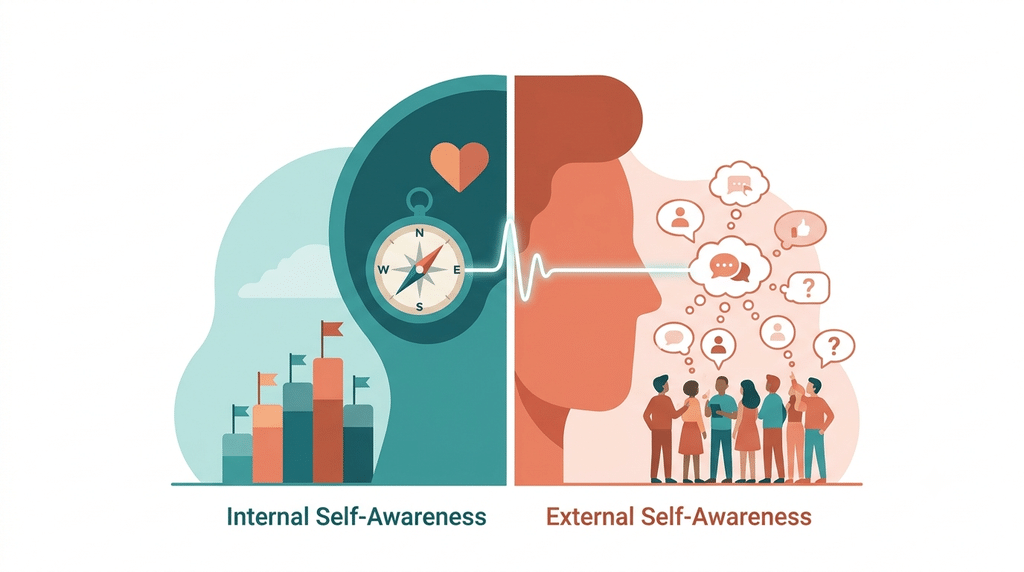
Most people practice only half of it. Eurich’s research splits Self Awareness into two parts.
Internal Self Awareness means knowing who you are: your values, your goals, your patterns, and your reactions. External Self Awareness means knowing how other people see you. Eurich reported that the two show virtually no relationship, so being strong in one tells you nothing about the other.
Here are two hypothetical examples that show the difference.
Riya, 22, joins a startup. She knows exactly what she wants: a Product Management career, and she understands that she learns fastest by building things. Her internal Self Awareness is high. But her manager reads her short, rushed updates as lack of effort, and Riya never finds out. Her external Self Awareness is low, so she loses trust without knowing why.
Karan, 19, studies for exams and dresses, talks, and posts exactly how his friends expect. Everyone likes him. But when someone asks what he wants from the next five years, he goes blank. His external Self Awareness is high and his internal Self Awareness is low. Eurich warned in a Wharton interview that people who focus too much on how others see them can lose track of their own interests entirely.
You need both halves. Internal Self Awareness gives you direction, and external Self Awareness gives you the feedback to correct it. Skip either one, and you run fast in the wrong direction or stand still in the right one.
The ROI of Self Awareness: Where It Saves Time and Money

Teenagers and new professionals both work with scarce resources: time, attention, and a small budget. Self Awareness helps you spend all three on the right things. Think about it as a return on investment that compounds.
It cuts wasted effort. Suppose you notice that you finish deep work in the morning and fade after lunch. You then move difficult tasks to the morning and save routine tasks for later. You do not work harder; you stop fighting your own pattern. One honest observation about yourself removes hours of friction every week.
It prevents expensive mistakes. A person who knows they buy things when they feel stressed can set a rule: wait 24 hours before any purchase above a fixed amount. A person who knows they agree to everything in meetings can practice one sentence: “Let me check my schedule and reply today.” Each pattern you name becomes a mistake you stop paying for.
It speeds up your career. Early in a job, your manager decides how fast you grow, and managers promote people who take feedback well. If you know how your team sees you, you fix small problems before they become reputations. You also choose roles that match your strengths, so you learn faster and compete better.
It sharpens your decisions. When you know your values, you say no to opportunities that look impressive but pull you off course. That single skill saves months. Many people spend years in a degree, a job, or a business that matches someone else’s expectations, and they only notice when the cost is already high.
Notice what these gains share: none of them needs money, a mentor, or special talent. They need honest observation, and you can start today.
A Five-Minute Self Awareness System You Can Start Today

Self Awareness sounds abstract until you attach it to a routine. Use this simple system.
Step 1: Ask “what,” not “why.” Eurich’s HBR article recommends this switch. “Why am I so bad at public speaking?” pulls you into excuses and self-blame. “What situations make me most nervous when I speak?” gives you a pattern you can test. Her research also found that people who reflect more are not automatically more self-aware, so the quality of your questions matters more than the quantity of your thinking.
Step 2: Write three lines every night. Spend five minutes answering: What did I do today that worked? What did I do that wasted time? What triggered my strongest emotion? After two weeks, patterns appear that you would never spot in your head.
Step 3: Collect outside data. Choose two or three people who will tell you the truth, such as a senior colleague, a friend, or a teacher. Ask one specific question: “What is one thing I do that makes my work harder to follow?” A specific question gets a specific answer, while “How am I doing?” gets a polite one. When you hear something uncomfortable, say thank you and write it down before you defend yourself.
Step 4: Test one change per week. Pick one pattern from your notes and adjust it. Move your hardest task to your peak hour, or send clearer updates. Then check your notes again. This turns Self Awareness into an experiment with a result, which means it produces real progress and not just insight.
Step 5: Review monthly. Compare your notes with the feedback you collected. Where do they match? Where do they clash? Each clash exposes a blind spot, and each blind spot you close raises the ceiling on what you can achieve.
You do not need a retreat, a coach, or a personality test to begin. You need a notebook, a few honest people, and the habit of asking better questions.
Self Awareness costs nothing and compounds every week you practice it, while blind spots charge you interest for as long as you ignore them. Start with one question tonight, because the person who sees themselves clearly decides faster, learns faster, and grows faster than everyone who guesses.
Written by mylifeconvert.com
External resources (facts cited above):
- Tasha Eurich, “What Self-Awareness Really Is (and How to Cultivate It),” Harvard Business Review: https://hbr.org/2018/01/what-self-awareness-really-is-and-how-to-cultivate-it
- Kruger & Dunning (1999), “Unskilled and Unaware of It,” Journal of Personality and Social Psychology: https://doi.org/10.1037/0022-3514.77.6.1121
- Knowledge at Wharton, interview with Tasha Eurich: https://knowledge.wharton.upenn.edu/?p=16941
- The Art of Manliness, Podcast #644 with Tasha Eurich: https://www.artofmanliness.com/podcast/podcast-644-how-to-develop-greater-self-awareness/
- WHYY, “What is self-awareness?” (Eurich and David Dunning): https://whyy.org/episodes/what-is-self-awareness/